
Granite or Basalt?
Don't take everything for granite!
Granite is an igneous rock composed of minerals like quartz, and feldspar along with some mica and hornblende. It is a large-grained colorful rock that forms below the surface cooling slowly allowing the molten magma to form large crystals. On or near the surface that molten rock, lava, cools more rapidly and forms smaller crystals and is known as basalt, with a mineral composition mostly of plagioclase feldspar, pyroxene, and olivine.
Granite is very recognizable for its colorful patterns of minerals and is often used as decorative stone for kitchen countertops, for example. On the other hand, basalt is less colorful given its typical dark black color and perhaps overlooked for that reason. However, basalt is very common compared to granite, as basalt makes up nearly all the surface volcanic rocks on our planet, both continental and oceanic crust as well as the mare, the ‘seas’, on the Moon which are basalt floods.


Basalt is found in many locations on our planet, especially where there is tectonic activity. Basalt is actively forming in areas like the East African Rift Valley where the crust is being pulled apart. Where plates meet In Iceland there are places where the mid-Atlantic Ridge is exposed with regular fissure-based eruptions of basalt. Under the Atlantic Ocean basalt flows from the fissures and undersea volcanic activity along the Mid-Atlantic Ridge.
Rocky Worlds
In addition to basalt on Earth and our Moon, basalt erupted onto the surfaces of Jupiter’s moon Io, the planets Mars, and Venus, and the asteroid Vesta. Is it safe to assume that a volcano on Mars, or Venus, or Jupiter’s moon Io spews out the same lava, basalt, as Earth-based volcanoes? How could we find out? It’s not like on one of my field trips where we collect pieces of rocks, literally getting our hands on the materials. Getting our hands on rocks from space is another story. We did get our ‘hands on’ with the samples returned by the Apollo Lunar Missions and we got materials from the asteroid belt or comets by way of meteorites or some sample return missions. However, rather than robotic, hands-on rocks from Mars, or Venus – not yet.
So, all of this leads to a question or questions about what Scientists use to learn about the surface of another world. On the surface of Mars, we are represented by the remotely controlled rovers that are equipped to observe, analyze, and even sample surface materials somewhat like a human Geologist might be doing. On the surface of Venus there were a few short-lived Landers that provided some insight into the surface of that inner planet. We also have the information we get from remote sensing techniques on Orbiters or spacecraft flybys of the other seven planets, dwarf planets, and Moons.
Two important instruments among the many packed aboard a spacecraft, lander, or rover are the Spectrometer and the Camera. Both instruments capture photons of light with the difference in what is done with those photons. A camera captures all of the wavelengths of light as visual data in the form of pictures and videos. It does this by focusing the light on a sensor, typically a CCD, charge coupled-device or a CMOS, complementary metal-oxide-semiconductor. The light signal is converted into electrical signals which are finally processed into an image.
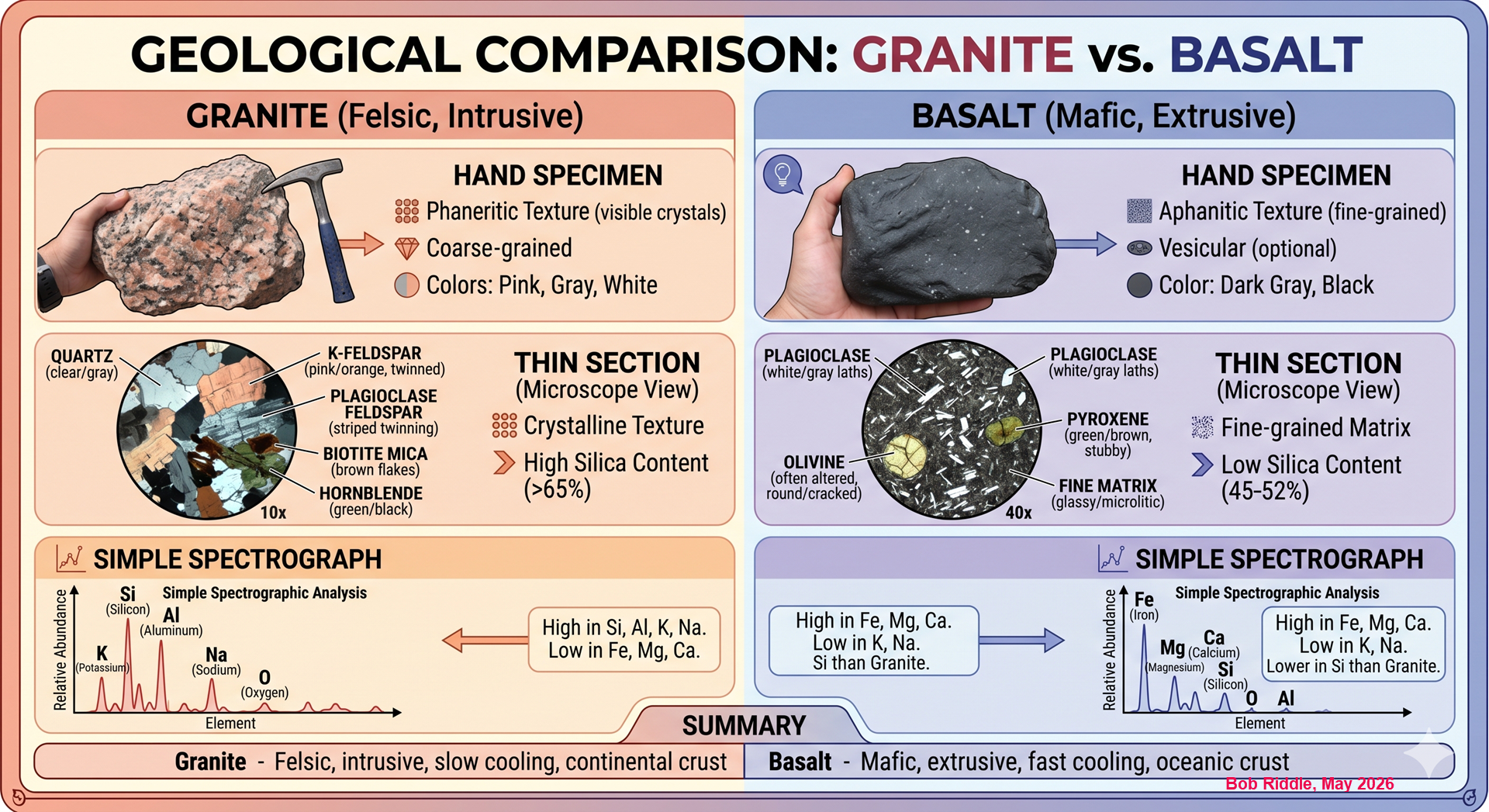
A Spectrometer does not provide an image like the camera but instead is used to analyze the light at each wavelength of light. The spectrometer analyzes rocks by measuring how the rocks interact with light. Different minerals and elements within a rock absorb, reflect, or emit light at specific wavelengths, creating a unique spectral “fingerprint.” By capturing and analyzing this spectrum, scientists can identify the rock’s composition.
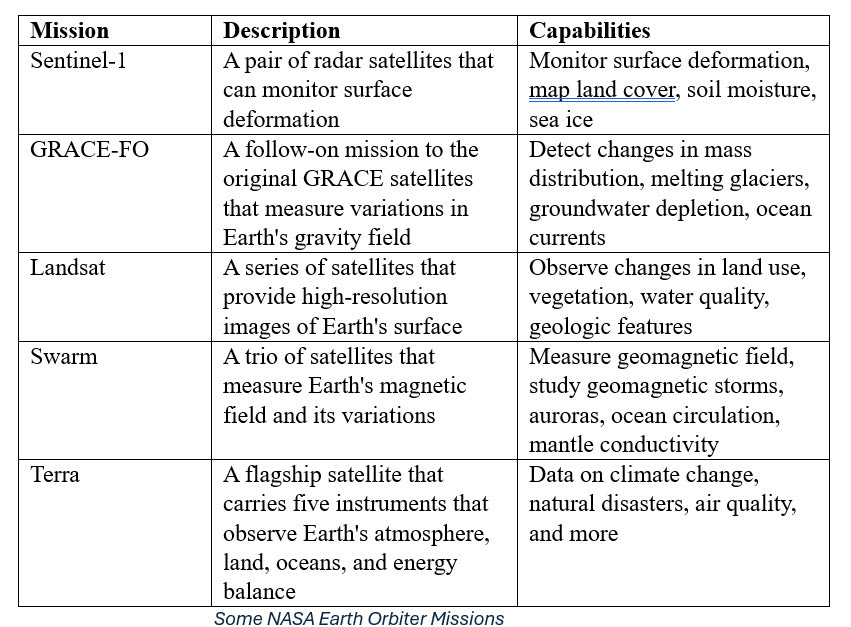
To be clear, there are many more instruments and techniques utilized by NASA for learning about the surface of the Earth from orbit. These Earth orbiters have missions that observe and monitor volcanoes, earthquakes, and changes in glaciers for example. When this data is combined with other sources like ground-based observations Scientists gain new insights about our planet.
Use these resources to learn more about NASA missions that rock!
Some Resources:
GRACE--gracefo.jpl.nasa.gov/
Missions to Mars--en.wikipedia.org/wiki/List_of_missions_to_mars
Missions to Venus--en.wikipedia.org/wiki/List_of_missions_to_Venus
Sentinel-1-- https://sentinels.copernicus.eu/
Swarm--earth.esa.int/web/guest/missions/esa-operational-eo-missions/swarm
Terra--terra.nasa.gov/
With this primer, it's hard to believe that the Rosetta Stone was misidentified as basalt (it's a type of granite) for almost 2 centuries!