March Skies
What's up this month
This month is packed with celestial alignments, headlined by a Total Lunar Eclipse of the Full Moon on the morning of the 3rd. The Moon remains a central figure throughout the month, making frequent conjunctions with prominent stars like Regulus, Spica, Antares, and Pollux, as well as the Pleiades cluster.
Some Astronomical Events
Beyond the Moon’s activity, the month marks significant planetary and seasonal shifts:
Solar Conjunctions: Both Neptune (22nd) and Saturn (25th) reach conjunction with the Sun, meaning they are positioned directly behind it from our perspective and hidden in the solar glare.
Mercury starts the month in the evening sky but quickly moves toward the Sun and Inferior Conjunction on the 7th. By March 17–18, it joins Mars in the pre-dawn sky for a “triple conjunction” with the crescent Moon—best viewed from an open area with a clear view of the southeastern horizon.
Venus is just beginning its climb into the evening sky. Look very low in the west-southwest about 30–45 minutes after sunset. On March 8, it will be extremely close to Saturn (use binoculars!), and on March 19–20, it will sit beautifully next to a thin crescent Moon.
Earth: Equinox: A major seasonal milestone occurs on the 20th with the March Equinox at 9:46 am CDT, signaling the start of spring in the Northern Hemisphere and autumn in the Southern Hemisphere.
Mars reaches its closest point to the Sun in its orbit, (26th), occurring the same day the Moon is in conjunction with Jupiter.
Jupiter remains the brightest “star” in the sky for most of the night. It is high in the southeast at dusk and stays visible for hours. On March 25–26, look for the Moon to be in conjunction with Jupiter.
Saturn & Neptune: Both planets are heading toward solar conjunction (passing behind the Sun).
Don’t Miss: The “Blood Moon” Eclipse
The absolute highlight for this month is the Total Lunar Eclipse on March 3. From my location near Kansas City, MO the total phase will be ending as the morning skies brighten and the Moon is setting. So the animated graphic below is set for my location so it shows the eclipse from start of total to when the sky got too bright.
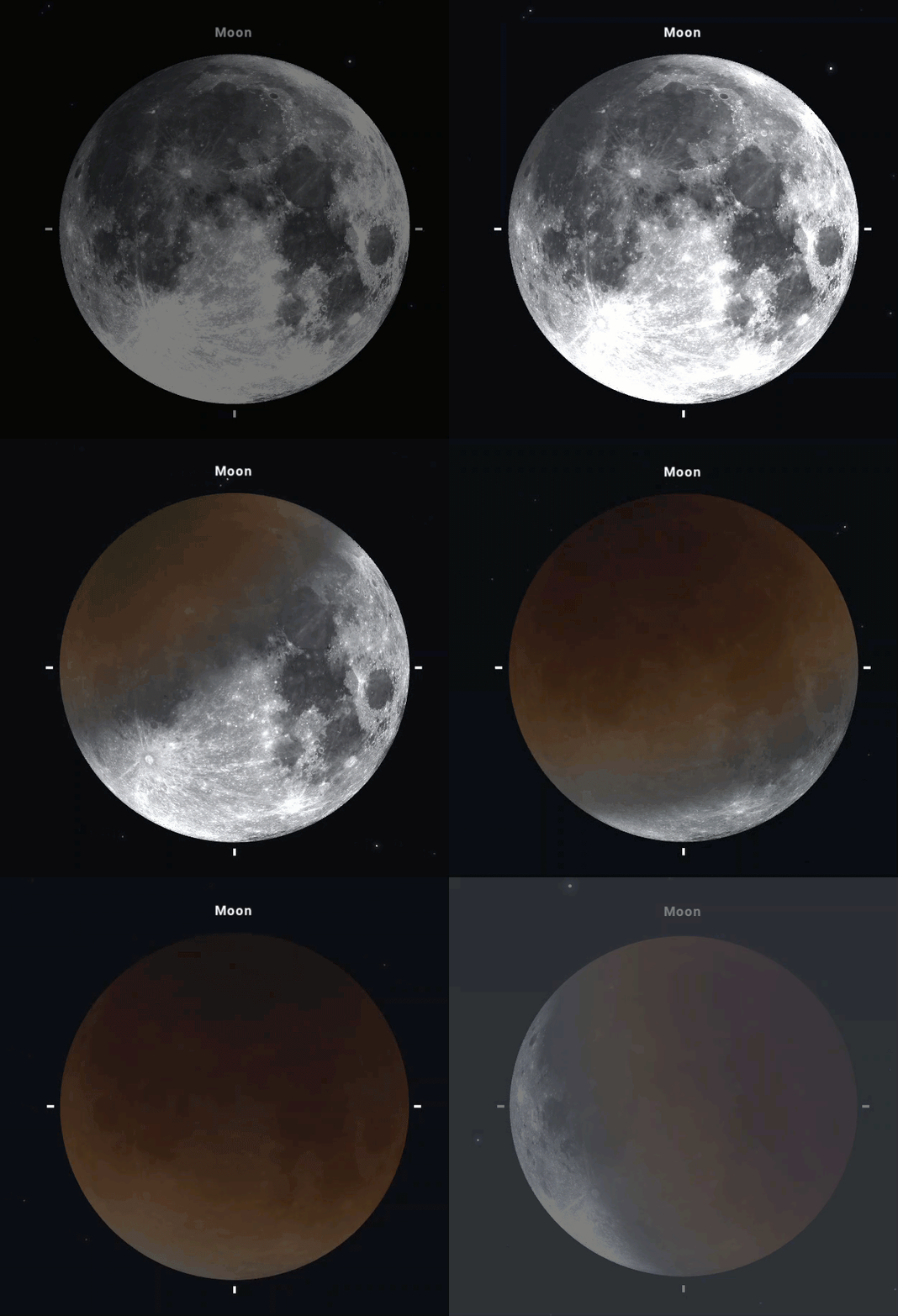
Timing: For North America, the action starts around 3:50 AM CST, with totality (when the Moon turns coppery-red) beginning around 5:04 AM CST.
Viewing Tip: Since the Moon will be setting in the West during the eclipse, find a spot with an unobstructed western horizon!
March Sky Calendar
02. Regulus – Moon Conjunction
Moon at Descending Node
03. Total Lunar Eclipse
Full Moon
06. Spica – Moon Conjunction
07. Mercury at Inferior Conjunction
08. Venus - Saturn Conjunction
10. Antares – Moon Conjunction
Moon at Apogee: 251,273 miles (404,385 km)
11. Last Quarter Moon
15. Mercury – Mars Conjunction
17. Mercury – Moon Conjunction
Moon at Ascending Node
Mars – Moon Conjunction
18. New Moon
20. Venus – Moon Conjunction
March Equinox -11:46 am EDT
22. Neptune in Conjunction with Sun
Moon at Perigee: 227,955 miles (366,858 km)
23. Moon near the Pleiades
25. Saturn in Conjunction with Sun
First Quarter Moon
26. Mars at Perihelion
Jupiter – Moon Conjunction
Pollux – Moon Conjunction
29. Regulus – Moon Conjunction
30. Moon at Descending Node